
Mobile Inspection System
Mobile Inspection System: Backscattered X-rays
introduction
Mobile Backscatter X-ray Inspection Systems provide a fast, nonintrusive way to detect hidden threats like explosives, weapons, and
drugs. Designed for use in areas without fixed inspection setups — like
borders, ports, or events— they combine advanced X-ray imaging with
the mobility of a van or truck to handle large items like vehicles and
cargo efficiently.
The Technology: How Backscatter Works
Backscatter X-ray technology differs from traditional X-ray systems by detecting radiation that reflects back from an object rather than passing through it. It uses low-dose X-rays, which scatter more from lighter, organic materials and less from denser materials like metals. By
measuring the intensity of the scattered radiation point-by-point, the
system creates images that highlight hidden organic substances and
anomalies.
Backscatter X-ray Technology : Key Advantages
One-Sided Imaging: Because the X-ray source and detectors are
positioned on the same side of the object, the system can perform
inspections even when access to the opposite side is impractical or
impossible. This is invaluable for scanning the sides and roofs of
vehicles, cargo containers stacked or positioned against walls, and even
building structures.
Backscatter X-ray Technology : Key Advantages
Mobility and Flexibility: Integrated onto a vehicle, the entire system can
be rapidly deployed to virtually any location. This mobility brings
advanced inspection capabilities to temporary checkpoints, remote
areas, or dynamically changing security perimeters, reducing reliance on
costly fixed infrastructure and increasing operational tempo.
Backscatter X-ray Technology : Key Advantages
Enhanced Material Detection: Backscatter systems excel at detecting
low-density organic materials that might be missed by other inspection
methods. Their sensitivity makes them highly effective for identifying
hidden explosives (bulk, sheet, or liquid), narcotics, large amounts of
currency, plastic weaponry, and even stowaways concealed within
vehicles or cargo. This capability often complements traditional
transmission X-ray systems, which are typically better at imaging dense
metallic objects.
Backscatter X-ray Technology : Applications
Border Security: Screening vehicles and cargo for contraband, weapons, and
undocumented individuals.
Ports and Cargo Facilities: Inspecting shipping containers and freight nonintrusively.
Event Security: Securing large public gatherings by scanning incoming
vehicles, equipment, and deliveries.
Critical Infrastructure Protection: Monitoring vehicles entering sensitive sites
like power plants or government buildings.
Law Enforcement: Providing support for searches and investigations requiring
non-destructive examination.
Backscatter X-ray Technology : Safety
While utilizing X-ray technology, these systems are designed with safety as a
priority. They employ low doses of radiation and incorporate integrated
shielding and clearly defined safety zones to protect both operators and the
public. Operators receive specific training in radiation safety protocols, and the
systems adhere to strict international safety standards
Backscatter X-ray Technology : Standards
| X-Ray Source Standards | Technical Standards | Applications |
|---|---|---|
| ASTM F1039; W2002 (21CFR 1020.40) | ANSI N42.44-2008 ASTM F792 – 2008 | Vehicle / Human Checkpoints |
| ASTM F1039; W2002 (21CFR 1020.40) | ANSI N42.45 – 2011 | CT / EDS |
| ANSI N43.16 – Draft IEC 62523 – 2010 ANSI N43.14 – 2011 | ANSI N42.46 – 2008 ANSI N42.41 – 2007 IEC 62523 – 2010 | Cargo Checkpoints |
| ANSI / HPS N43.17 – 2009 ANSI / ANS 6.1.1 – 1991 IEC 62463 – 2010 | ANSI N 42.47 – 2010 IEC 62709 – CD1 | Full Body Scanning |
| ANSI / HPS N43.3 – 2008 | NIJ 0603.01 ANSI N42.55 – Draft | Bomb Disposal Unit |
Backscatter X-ray Technology : Product Specification
| Technical Specification | |
|---|---|
| Total Input Power | 16KVA |
| X-Ray Tube Voltage | 1225KV |
| Duty Cycle | 100% |
| Scanning Speed | 1- 10 Km/h |
| Working Temperature | -20 – 70 c |
| Working Humidity | 10 – 98% |
| Equivalent Dose (Per Scan) | < 10 μSv |
| Absorbed Dose (Inside Cabin) | < 0.5 μSv / h |
| Absorbed Dose (Outside Cabin) | < 0.1 μSv / h |
| Image Resolution | 1.0 cm |
| Relative Penetration Depth (Compared to Steel) | 6.0 mm |
| Cooling Technology | Closed Recirculated Cooling System |
Backscatter X-ray Technology : Case Studies
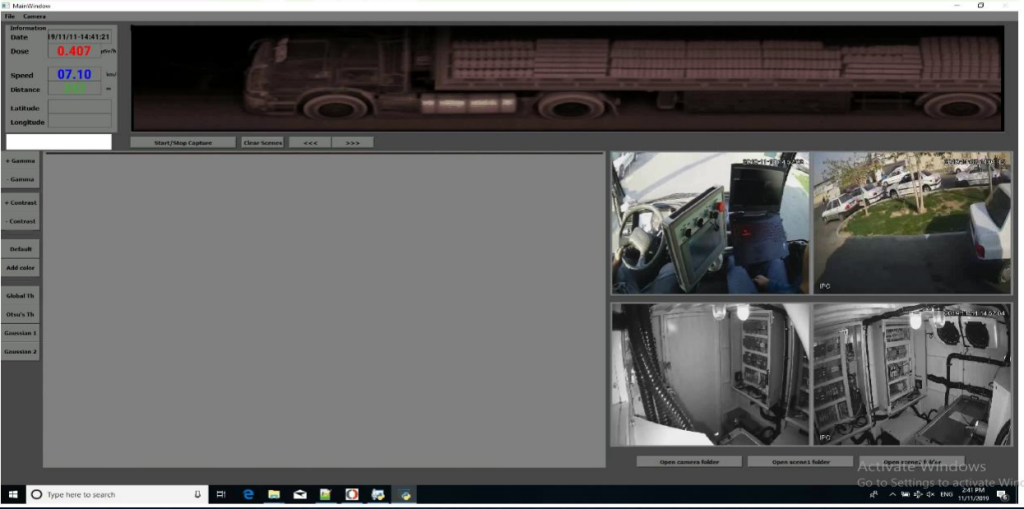
Backscatter X-ray Technology : Case Studies
